
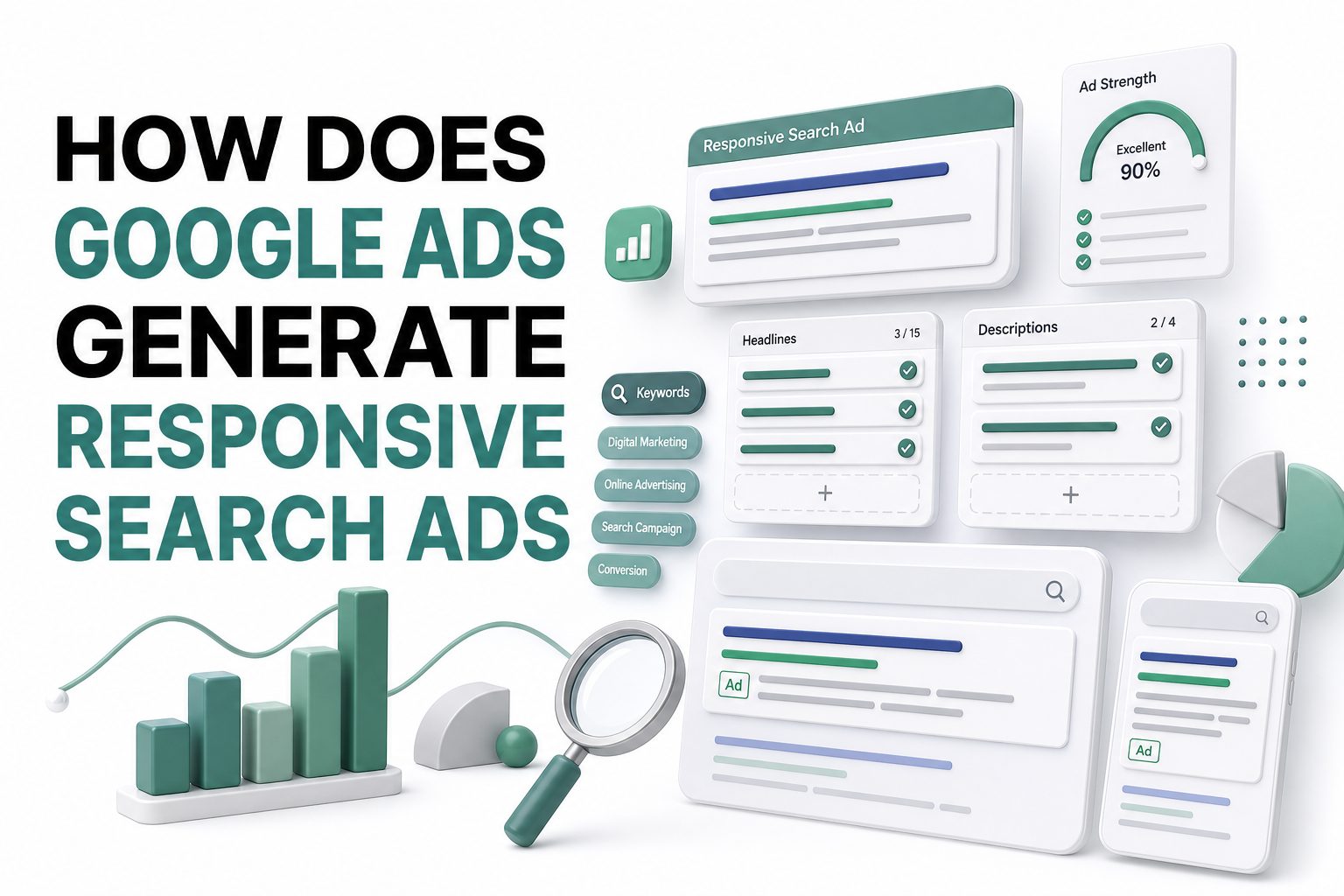
Responsive search ads are built from multiple headlines and descriptions that advertisers provide inside Google Ads. Instead of showing one fixed ad version, Google Ads mixes eligible assets to create different ad combinations for search users.
The system checks the search query, device, location, past performance, and asset relevance before choosing which combination may appear. This lets one ad adapt to many search situations without creating dozens of manual text ads.
For advertisers, this means the writing process changes. You are no longer writing one perfect ad. You are writing a strong set of flexible assets that can work together in several useful ways.
How Google Ads Builds Ad Combinations
Google Ads starts with the headlines and descriptions entered in the responsive search ad setup. Advertisers can add several headline options and multiple description lines, giving the system more material to test and match.
When a user searches, Google Ads reviews the available assets and predicts which combination fits the query and auction context. The final ad may include different headlines and descriptions depending on that moment.
This process is not random. Google uses machine learning signals and performance history to decide which asset combinations are more likely to earn clicks, match intent, and support the advertiser’s campaign goal.
Core inputs Google uses:
Asset relevance: How closely headlines and descriptions match the search query.
Expected performance: How likely a combination is to drive clicks or conversions.
Ad strength: How varied, specific, and useful the assets are.
Policy status: Whether each asset is approved and eligible.
Pinning settings: Whether the advertiser has locked assets into certain positions.
The Role of Headlines
Headlines carry the most visible message in a responsive search ad. They often include the product, service, offer, brand name, location, or value point that makes the ad relevant to the searcher.
Google Ads may show up to three headlines in one ad, depending on available space and placement. Because not every headline appears every time, each headline should make sense on its own.
Good headline sets include variety. Some headlines can focus on keywords, while others highlight benefits, trust factors, pricing, speed, or service quality. Repeating the same idea limits Google’s ability to test useful combinations.
The Role of Descriptions
Descriptions give the ad more context and help users decide whether to click. They can explain the offer, mention proof points, support a call to action, or clarify what the visitor will find after clicking.
Google Ads may show one or two descriptions, depending on space and relevance. Since the final pairing can vary, each description should read naturally with many possible headlines.
Strong descriptions avoid vague claims. They give practical information, such as service coverage, delivery options, consultation details, pricing cues, or customer benefits that support the user’s search intent.
Asset Mixing and Machine Learning
Responsive search ads depend on Google’s machine learning to test many combinations over time. The system learns from impressions, clicks, conversions, and other auction signals to improve future ad selection.
Early performance may shift as the system gathers data. Some assets may appear more often because Google predicts stronger results, while others may receive fewer impressions due to lower relevance or weak engagement.
This is why advertisers should judge assets with enough data. A headline that performs poorly in one campaign may work well in another if the audience, keyword theme, or landing page intent is different.
How Search Intent Shapes the Final Ad
Search intent is one of the strongest factors behind ad generation. A person searching for pricing needs a different message than someone searching for features, nearby service, or a brand comparison.
Google Ads tries to match the ad combination to the intent behind the query. A search containing “near me” may favor local headlines, while a product-focused search may favor feature or benefit headlines.
Advertisers improve results by writing assets for different intent types. This gives Google enough options to serve a more suitable message without making the ad feel generic or disconnected.
Intent-based asset examples:
Commercial intent: “Compare Plans Today” or “Flexible Pricing Options”
Local intent: “Serving Austin Businesses” or “Local Support Team”
Urgent intent: “Book Same-Day Service” or “Fast Setup Available”
Trust intent: “Rated by Real Customers” or “Certified Specialists”
Brand intent: “Official Service Provider” or “Work With Our Team”
Ad Strength and Asset Quality
Ad strength is a Google Ads indicator that reviews the quality, variety, and relevance of your responsive search ad assets. It is a guide, not a final measure of profit or campaign success.
A stronger ad usually includes diverse headlines, clear descriptions, and relevant keyword coverage. Google rewards variety because it gives the system more combinations to test across different searches.
Still, ad strength should not replace business judgment. A high ad strength score is useful, but conversions, lead quality, cost per acquisition, and revenue remain the more important performance signals.
Keyword Relevance in Responsive Search Ads
Keywords still matter because responsive search ads are triggered through campaign targeting. When the ad assets closely match keyword themes, Google can form combinations that feel more relevant to the searcher.
The primary keyword should appear naturally in the ad group’s theme, landing page, and selected assets. Overusing the same phrase across every headline can make the ad repetitive and reduce message variety.
For deeper campaign planning, an internal guide such as /google-ads-keyword-strategy/ can support keyword grouping, match type selection, and ad copy alignment across different search intent levels.
Pinning Headlines and Descriptions
Pinning lets advertisers force a headline or description to appear in a specific position. This is useful when legal disclaimers, brand rules, or required offers must always appear in the ad.
However, pinning can reduce Google’s ability to test combinations. If too many assets are pinned, the ad becomes less flexible and may lose some benefits of responsive search ad automation.
Use pinning carefully. Pin only the assets that must appear for compliance or brand control, then leave the rest open so Google can test stronger combinations across different search contexts.
Landing Page Alignment
Google Ads does not generate responsive search ads in isolation. The landing page affects quality, user experience, and conversion potential after the click, which can influence overall campaign performance.
If an ad promotes fast quotes, the landing page should make quote requests easy. If the ad mentions a product category, the landing page should take users directly to that category.
Good alignment improves trust. Users should feel that the ad they clicked and the page they reached belong to the same journey, with clear copy, visible actions, and relevant information.
Performance Signals Behind Ad Selection
Google Ads uses many performance signals when deciding which responsive search ad assets to show. These signals include click behavior, conversion data, device type, search term context, and auction competition.
The system may favor combinations that bring stronger engagement or better conversion outcomes. If conversion tracking is set correctly, Google can better connect ad combinations to meaningful business actions.
Without accurate conversion tracking, optimization becomes weaker. Google may focus more heavily on clicks, which can increase traffic but may not always improve lead quality or sales results.
Useful performance checks:
Conversion rate by campaign and ad group.
Cost per conversion over a stable time period.
Search terms that trigger strong or weak traffic.
Asset performance labels inside Google Ads.
Landing page behavior from paid search visitors.
Lead quality after form submission or phone call.
Writing Assets That Work Together
Responsive search ads perform better when each asset can pair naturally with others. A headline should not depend on one specific description to make sense, because Google may combine it differently.
Write headlines that cover different angles. Include service terms, audience pain points, benefits, proof, offers, and brand trust. This creates a wider testing field without turning the ad into a list of repeated keywords.
Descriptions should add context instead of copying headlines. If a headline says “Fast CRM Setup,” the description can explain onboarding, support, or integration help rather than repeating the same phrase.
Common Mistakes to Avoid
One common mistake is writing nearly identical headlines. When every headline says the same thing with small wording changes, Google has fewer meaningful options to test across different search queries.
Another mistake is stuffing keywords into every asset. This can make the ad sound robotic and may reduce user trust. Natural language usually performs better when it still matches search intent.
A third mistake is ignoring asset reports. Responsive search ads improve over time when advertisers remove weak assets, test better messages, and keep copy aligned with real campaign data.
Optimization Workflow for Better Results
Start by creating tightly themed ad groups. Each ad group should focus on a clear keyword cluster, service category, product type, or audience need so the responsive search ad can stay relevant.
Next, write assets that reflect that theme from several angles. Add enough variety for Google to test, but keep every headline and description connected to the same user problem or offer.
Review performance after the ad has enough impressions and conversions. Replace weak assets carefully, test new messaging, and compare results over time instead of changing everything too quickly.
For a practical checklist, you can connect this process with an internal resource like /responsive-search-ads-best-practices/ to keep asset writing, testing, and reporting consistent across campaigns.
How Many Assets Should Be Added
Google allows multiple headlines and descriptions in responsive search ads. Adding more high-quality assets gives the system more possible combinations, but quality matters more than filling every available slot.
A strong ad often includes a mix of keyword-focused headlines, benefit-focused headlines, trust signals, and action-oriented lines. Descriptions should support these angles with clear details and a natural next step.
Avoid adding weak assets just to reach a number. If a headline does not add a new message or useful angle, it may dilute testing and create less effective combinations.
Brand Voice in Responsive Search Ads
Brand voice still matters, even when Google is assembling the final ad. Your assets should sound like they come from the same company, with consistent tone, promise, and level of formality.
If your brand is professional and direct, avoid exaggerated claims. If your brand is friendly and simple, keep the language clear and conversational without losing credibility or search relevance.
Consistency helps users trust the ad. Even when Google changes the order of headlines and descriptions, the final message should feel coherent, useful, and aligned with the landing page.
Compliance and Policy Review
Before responsive search ads can run, Google reviews assets against advertising policies. Disapproved headlines or descriptions cannot serve, which may reduce the available combinations for the ad.
Policy issues can involve restricted industries, misleading claims, trademark usage, punctuation, capitalization, or unsupported offers. Advertisers should check asset status regularly, especially after editing or launching new campaigns.
For sensitive categories, compliance should be built into the writing process. Clear claims, accurate offers, and approved wording reduce delays and keep campaigns eligible in competitive auctions.
Measuring Success Beyond Clicks
Clicks are useful, but they do not tell the whole story. A responsive search ad can earn many clicks while still failing to generate quality leads, purchases, or booked appointments.
Measure success with business-focused metrics. Conversion value, cost per qualified lead, return on ad spend, and customer acquisition cost give a more accurate picture of ad performance.
Asset reports should support these decisions. If certain messages drive traffic but poor leads, replace them with copy that better filters intent and attracts users closer to the right action.
Responsive Search Ads and Manual Control
Responsive search ads reduce the need to manually build every ad variation. Instead of writing many separate ads, advertisers provide assets and let Google assemble combinations based on context.
This does not mean advertisers lose all control. You still control campaign structure, keywords, landing pages, assets, brand language, pinning, budgets, bidding strategy, and conversion tracking quality.
The best results usually come from balance. Let automation test combinations, but guide it with strong inputs, clean account structure, useful data, and regular human review.
Practical Example of Asset Strategy
A software company selling project management tools might write headlines for time savings, team collaboration, reporting, integrations, pricing, and free trials. Each headline targets a different search motivation.
Descriptions could mention setup speed, support options, workflow visibility, and the type of teams the software serves. This gives Google useful combinations for users comparing tools or ready to start.
The final ad shown for “project management software for agencies” may use agency-focused and collaboration-focused assets. A different search, such as “simple project tracking tool,” may trigger clarity and ease-of-use messaging.
Conclusion
Responsive search ads work best when advertisers provide clear, varied, and relevant assets that Google can combine for different search contexts. The system uses headlines, descriptions, intent signals, performance data, and eligibility rules to decide which version appears.
The main idea behind how does google ads generate responsive search ads is simple: advertisers supply the building blocks, and Google Ads uses automation to assemble the most suitable message for each eligible search.
Strong results depend on quality inputs. Relevant keywords, useful copy, aligned landing pages, accurate tracking, and steady optimization all help responsive search ads become more effective over time.
FAQ
How many headlines should a responsive search ad have?
A responsive search ad should include enough headlines to give Google useful variety. Aim for distinct messages covering keywords, benefits, trust, offers, and actions. Avoid repeating the same idea with slightly different wording.
Can Google change my responsive search ad text?
Google does not rewrite your submitted assets in the standard setup. It combines approved headlines and descriptions you provide. The final ad can look different each time because asset order and selection may change.
Should every headline include the main keyword?
No, every headline should not repeat the same keyword. Use the main keyword naturally in some assets, then add benefit, trust, location, offer, or action-focused headlines to create better variety.
Is pinning bad for responsive search ads?
Pinning is not bad when used for brand, legal, or offer requirements. Too much pinning can limit testing and reduce flexibility, so it is best used only when a message must appear in a fixed position.
How often should responsive search ads be optimized?
Review responsive search ads after they collect enough impressions and conversion data. Monthly reviews work for many accounts, but high-spend campaigns may need closer checks to replace weak assets and test better messaging.
0 Comments